Living beside the Hindburn River at Mill Farm:
Colin Miller looks back

Mill Farm in the 1960s
Click to enlarge
Mill Farm (now Millhouse Farm) sits on the banks of the river in Millhouses. Nearby is a deep pool which is
ideal for swimming. About 250 yards upstream is the Force, so called because
when the river is low all the water flows through a gap between the rocks and it
becomes possible to stride over the torrent.
Below is a waterfall with a very deep pool at the bottom. It was here,
one hot day, that a builder who had been at working at Cragg Hall came
down for a swim and was drowned. About 200 yards downstream of the farm a
member of the Bateston family was drowned: two tragedies within a short
distance, and doubtless the reason why a nearby sign now forbids swimming.
During the summer it was possible to watch sea trout leaping up the
falls, trying to get to their spawning grounds upsteam, above Tatham
Fells. The sea trout would leave Morecambe Bay, travel up the rivers Lune
and Wenning, and then up the Hindburn to find where they had been spawned.

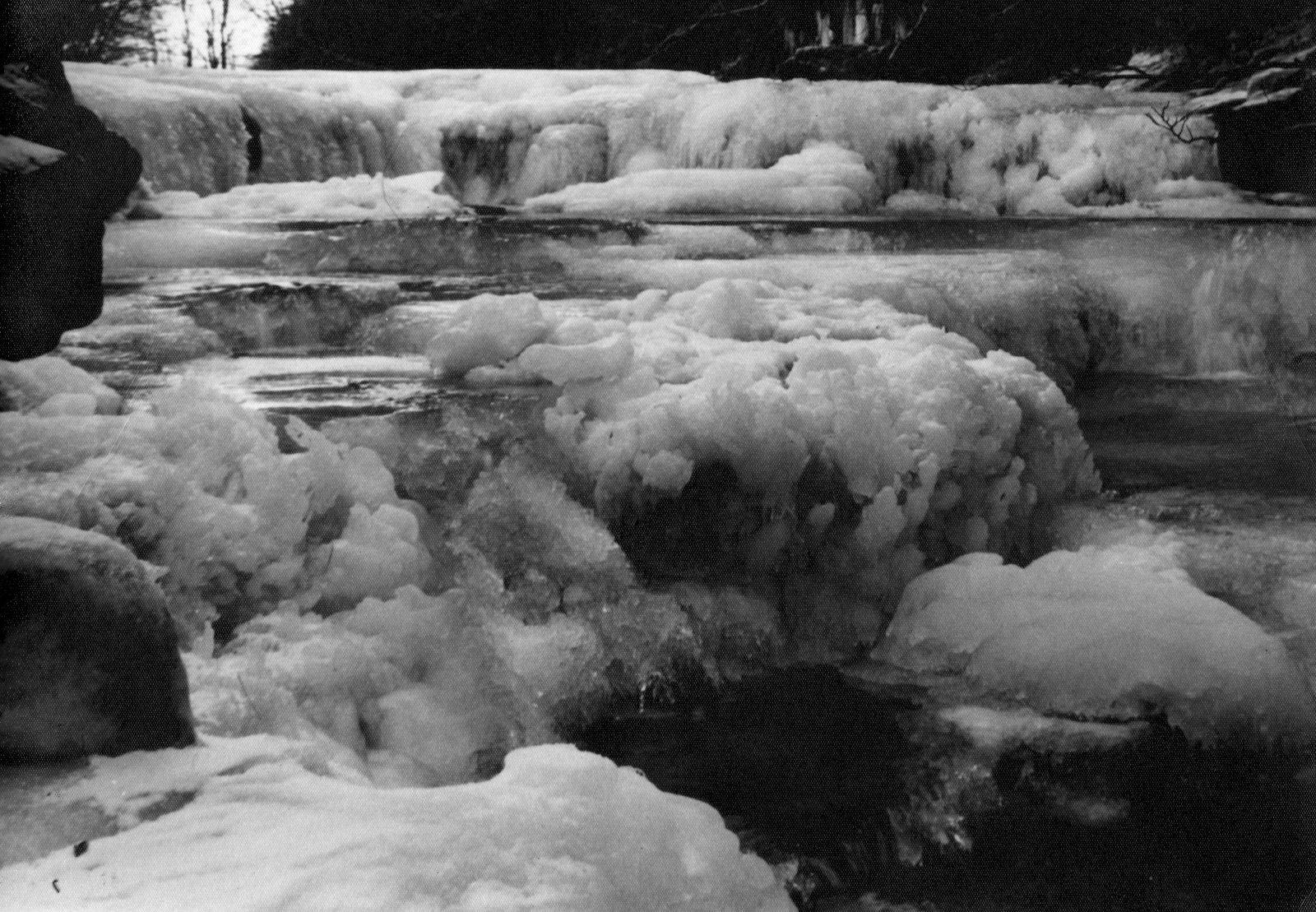
Hindburn Falls during the 1962-3 winter
Click to enlarge
During the very cold winter of 1962-3, the river froze over. The water
pipes to the house also froze, so we were reduced to breaking ice in the
river in order to get water for the house and farm stock. When the thaw
came, it was sudden; the river flooded, and large blocks of ice came
crashing down the river past the farm.
There was a lovely bridge over the river taking a track across, and
then up to Cragg Hall. During one particularly heavy flood the bridge was
blocked up with trees, badly damaging the structure and diverting water
through the fields, which were left strewn with debris. Luckily the wall
across the field diverted most of the water back towards the river.
However the millstream overflowed, flooding the farmyard.
About 100 yards upstream from the farm there is a path down to the
riverside, from where you can walk upstream to the waterfall, or
downstream to the pool below the farm. Alongside the river there is a
large collection of stones (called Beckstones) where as kids we spent
hours playing, looking for stones with fancy marks on them or flat thin
ones which we would try to skim across the water.
About 500 yards upstream from the farm, there was a wooden weir across
the river, with a metal grid over the entrance to a 24-inch diameter pipe.
This carried water 25 yards to a basin which was the start of the
millstream. Near the basin is the remains of an earlier stone weir. The
millstream flowed through the meadows and pastures towards the Mill,
providing drinking water to the animals in the fields. There were small
trout, eels and bullheads in the stream, and watercress grew along the
banks. Herons flapped along, dippers dipped from stones in the stream.
Across the stream close to the farm, there was a bridge under which
a large eel lived; it was there for years and was still there when the
stream was no longer in use and became just a ditch.
A good mile upstream was Spens farm, where my father [John] grew up. He
married in about 1932 and took up the tenancy at Mill Farm, where I grew
up. My grandfather [Edward] farmed at Spens until about 1941. Behind Spens house,
in some woodland, there was a partly walled garden (now derelict) with its
own micro-climate. There my grandfather, who had been a gardener before
taking up farming, grew all manner of fruit and vegetables. There was a
greenhouse, in which grew luscious black grapes and peaches. We would walk
up to Spens from Mill Farm whenever the river was low enough to walk
beside, to save ourselves a longer walk through the fields higher up the
valley.
Click here for old Spens photos, including portraits of the author's
grandparents, and a 1930s photo of the author at Spens with his
sisters; you can also follow a further link to more information on the
Miller family, and on the author's grandfather's time at Spens.
Neither Mill Farm nor Spens are farms today, and both have been
modernised.
Tatham History Society members visited Spens, and
what remains of its walled garden, in 2012.
Click here for photos
|